

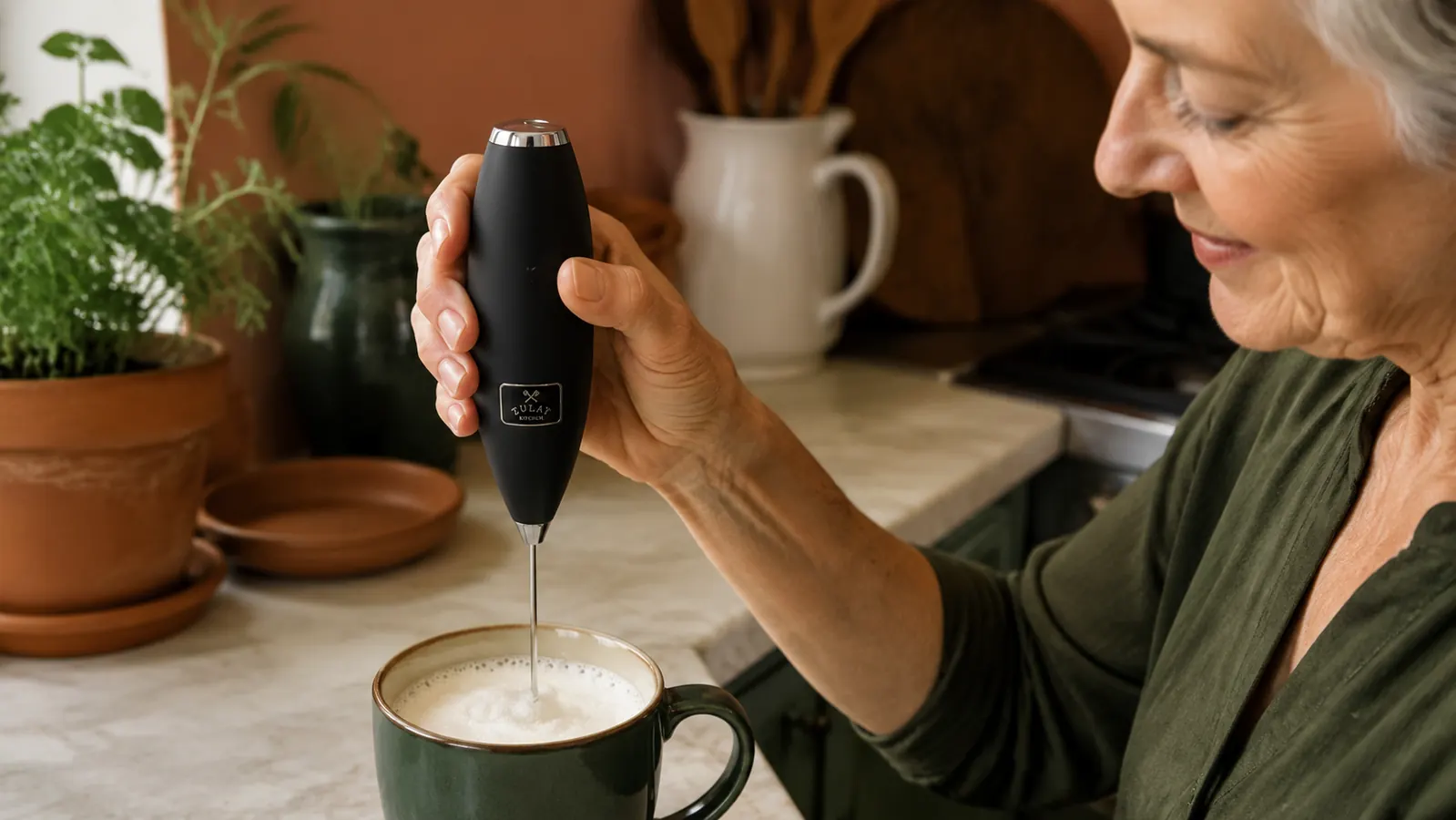
I bought the Zulay Kitchen Handheld Milk Frother back in January, mostly on a whim, because I was tired of paying four dollars for a latte I could make at home in ninety seconds. Six months later it's still sitting in the same drawer next to my spoons, and it still gets pulled out every single morning without fail. That's longer than most nine-dollar kitchen gadgets survive in my house, so I figured it earned a real review.
I downsized from a four-bedroom house to a one-bedroom condo two years ago, and my kitchen went from having a full espresso setup to having about eighteen inches of counter space total. A milk frother that lives in a drawer instead of taking up a corner was exactly the kind of trade I needed to make. This is what six months of daily use actually looks like, warts and all.
The Quick Verdict
A genuinely useful nine-dollar tool that earns its drawer space every day, though the battery cover feels cheap and the foam thins out on very low-fat milk.
Amazon Check Today's Price →Still Making Instant Coffee Taste Like a Corner Cafe
Nine dollars and a AA battery is all it takes to turn a plain mug of coffee into something that actually tastes like it came from a cafe. Check today's price and see why it's got over 237,000 ratings.
Amazon Check Today's Price on Amazon →How I've Used It
My routine hasn't changed much since week one. I heat about a third of a cup of milk in the microwave for 30 to 35 seconds, drop the whisk head in at an angle so it doesn't splash, and run it for 15 to 20 seconds until I've got a good layer of foam. Then I pour it over coffee, or matcha on the days I'm avoiding caffeine after 2pm, or a protein shake when I'm trying to be virtuous. It's a three-times-a-day tool in my house, not an occasional one.
I never tested it as a novelty. I tested it as a replacement for a daily habit, and that's really the only fair way to judge something this cheap. Anything can impress you once. The question is whether it still works the same on day 140 as it did on day 1, and that's the whole reason I waited this long to actually sit down and write about it.
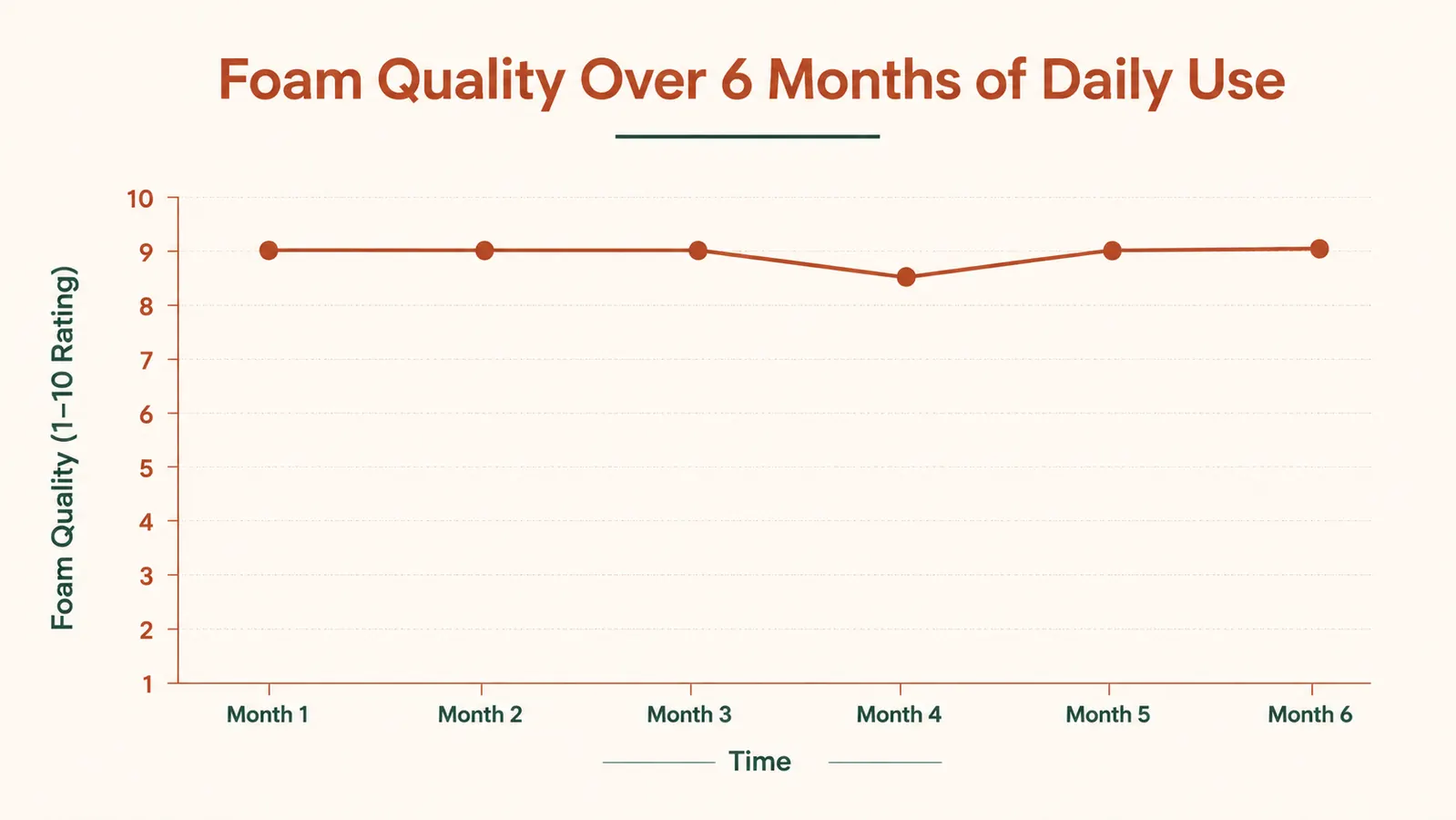
Short answer, it does. The motor sounds identical to how it sounded in January. No grinding, no slowdown, no weird burning smell that some cheap motors develop after a few months of daily use. I was honestly bracing for it to die around month three, since that's usually when budget gadgets show their age, but it just kept going.
I also travel with it more than I expected to. It's small enough to toss in a toiletry bag, and I brought it along on a trip to visit my daughter in April and again to a lake house rental in June. Both places had coffee makers but no frother, and both times I was glad I'd packed it. That portability isn't something I anticipated caring about when I bought it, but it's turned into one of the bigger reasons I keep recommending it to friends. My daughter actually asked to borrow mine for a weekend and ended up ordering her own before I even left town.
Foam Quality, Six Months In
The foam this thing produces on whole milk is genuinely close to what I used to get out of my old countertop steamer, minus the microfoam a real barista pulls off with a steam wand. It's not going to give you latte art, but it gives you a thick, stable foam that sits on top of coffee for a few minutes instead of collapsing immediately.
Oat milk froths well too, better than I expected honestly, though it needs a slightly longer run time, closer to 25 seconds. Skim milk is where it struggles. The foam is thinner and disappears faster, which isn't really the frother's fault since skim milk has less fat to hold air, but it's worth knowing going in if that's your daily milk.
Almond milk is hit or miss depending on the brand. The unsweetened Silk version I buy froths decently. A cheaper store brand I tried in March barely foamed at all. That's more about the milk's protein content than the frother, but it's the kind of detail that only shows up after months of actually using the thing across different products.
I did a rough side-by-side test in May, just out of curiosity, timing how long the foam held up on four different milks poured over the same cup of black coffee. Whole milk held a visible foam cap for about six minutes before it started thinning. Oat milk held for close to five. Unsweetened almond milk from the good brand held around three and a half minutes. Skim milk was down to a thin film after ninety seconds. None of that is scientific, but it matched what I'd already noticed just from drinking the stuff every day, and it's worth doing your own version of that test if you're deciding between milk types for your regular order.
Battery Life and the One Real Weak Spot
It runs on a single AA battery, and I've gone through two batteries in six months, using it roughly three times a day. That works out to somewhere around 250 to 270 uses per battery, which feels reasonable for a nine-dollar device. I keep a spare battery in the same drawer now so I'm never caught mid-froth with a dying motor. When the battery does start to go, you notice it as a gradual slowdown over a couple of days rather than a sudden stop, so there's fair warning before it quits on you mid-mug.
The one part that's genuinely a little cheap feeling is the battery compartment cover. It's a twist-off cap, and mine has developed a slightly looser fit than it had on day one. It still stays on fine during use, it's just not as snug as I'd like when I'm changing the battery. Nothing that's caused a problem, but it's the one component where you can feel the price point, and if I'm being picky it's the single thing I'd ask Zulay to improve on a future version.
The whisk head itself has held up better than the battery cover. No rust, no bent wires, no wobble in the spinning mechanism. I rinse it under hot water after every single use and it still looks close to new. I did notice a very faint milk smell developing around month two, which a quick soak in warm soapy water once a week completely took care of. If you skip that weekly deep clean and just rinse, the smell can creep in a bit faster, especially if you're using dairy milk more than plant-based.
How It Compares to My Old Countertop Steamer
Before I downsized, I had a proper countertop milk steamer that plugged into the wall and lived on my counter permanently. It made better foam, no argument there, tighter bubbles and more of that silky microfoam texture. But it also took up real counter space I no longer have, needed its own cleaning routine with a carafe and a lid, and cost about six times what this handheld version does.
For the difference in results, especially on a normal weekday when I just want foam on my coffee and I'm not trying to impress anyone, the handheld wand gets me there in a fraction of the time with zero cleanup beyond a rinse. I don't miss the steamer nearly as much as I thought I would when I first packed it up for the move. The only time I really wish I still had it is when I'm hosting a few people at once and want everyone's drink to look a little more polished.
Other Frothers I Considered First
Before landing on the Zulay, I looked at two other options. A battery-free spring-loaded pump frother in a jar, the kind you shake and then microwave, and a small rechargeable USB model a neighbor already owned. The pump jar was cheap but the foam it produced was inconsistent, sometimes great, sometimes flat, and I never figured out why. The rechargeable version my neighbor has works fine, but she's had to replace the charging cable twice, and I liked the idea of a plain AA battery I can pick up anywhere, including the gas station down the road, rather than hunting for a specific charging cord.
I also seriously weighed just buying a small standalone electric frother, the kind that heats and froths in one covered pitcher. Those do a genuinely nice job and I'd used one at my sister's place. But it's another appliance taking up counter space I don't have, and for the two mugs a day I actually drink, it felt like overkill. The handheld wand does about ninety percent of what that pitcher does, for about a fifth of the price and none of the storage commitment.

Who This Frother Is Best For
If you're making one or two frothed drinks a day and you don't want a bulky electric frother machine taking up counter space, this is close to ideal. It stores in a drawer, it's dishwasher-unfriendly but rinses clean in ten seconds, and the price means you're not out much if you decide frothing at home just isn't your thing.
What I Liked
- Still runs like new after 6 months of daily 3x-a-day use
- Foams whole milk and oat milk noticeably well
- Fits in a drawer, no counter space needed
- Cheap enough that replacing it isn't a big deal
- Rinses clean in seconds, no real cleanup routine
- Small enough to travel with
- Runs on a plain AA battery you can find anywhere
Where It Falls Short
- Battery compartment cover feels loose after repeated changes
- Skim milk and cheap almond milk brands froth thin
- No off switch, you hold the button the whole time
- Doesn't come close to real microfoam for latte art
- Needs a weekly soapy soak or a faint milk smell can develop
I was bracing for it to die around month three, like most cheap gadgets do. It just kept going, same sound, same foam, six months later.
Who This Is For
This is for anyone in a small kitchen who wants café-style coffee without a café-sized machine. It's for the person making one mug at a time, not a household of four all wanting lattes simultaneously. If your kitchen counter is precious real estate, like mine, a tool that lives entirely inside a drawer and still delivers real foam is close to a perfect fit. It's also a smart pick for anyone who travels regularly and doesn't want to give up their morning routine on the road.
Who Should Skip It
If you're regularly frothing for more than two or three people at once, the single-battery motor will start to feel slow, since you're running it back to back multiple times in a row. And if you're chasing genuine microfoam for latte art, you'll want an electric steam wand or a standalone frother instead. This tool gets you 85 percent of the way there for a fraction of the price and none of the counter space, but it has a ceiling, and it's worth knowing that ceiling exists before you buy.
Six Months, Two Batteries, Still My Everyday Frother
If a nine-dollar tool can survive six months of daily coffee in my kitchen without missing a beat, it's earned a permanent spot in the drawer. See today's price and reviews for yourself.
Amazon Check Today's Price on Amazon →