
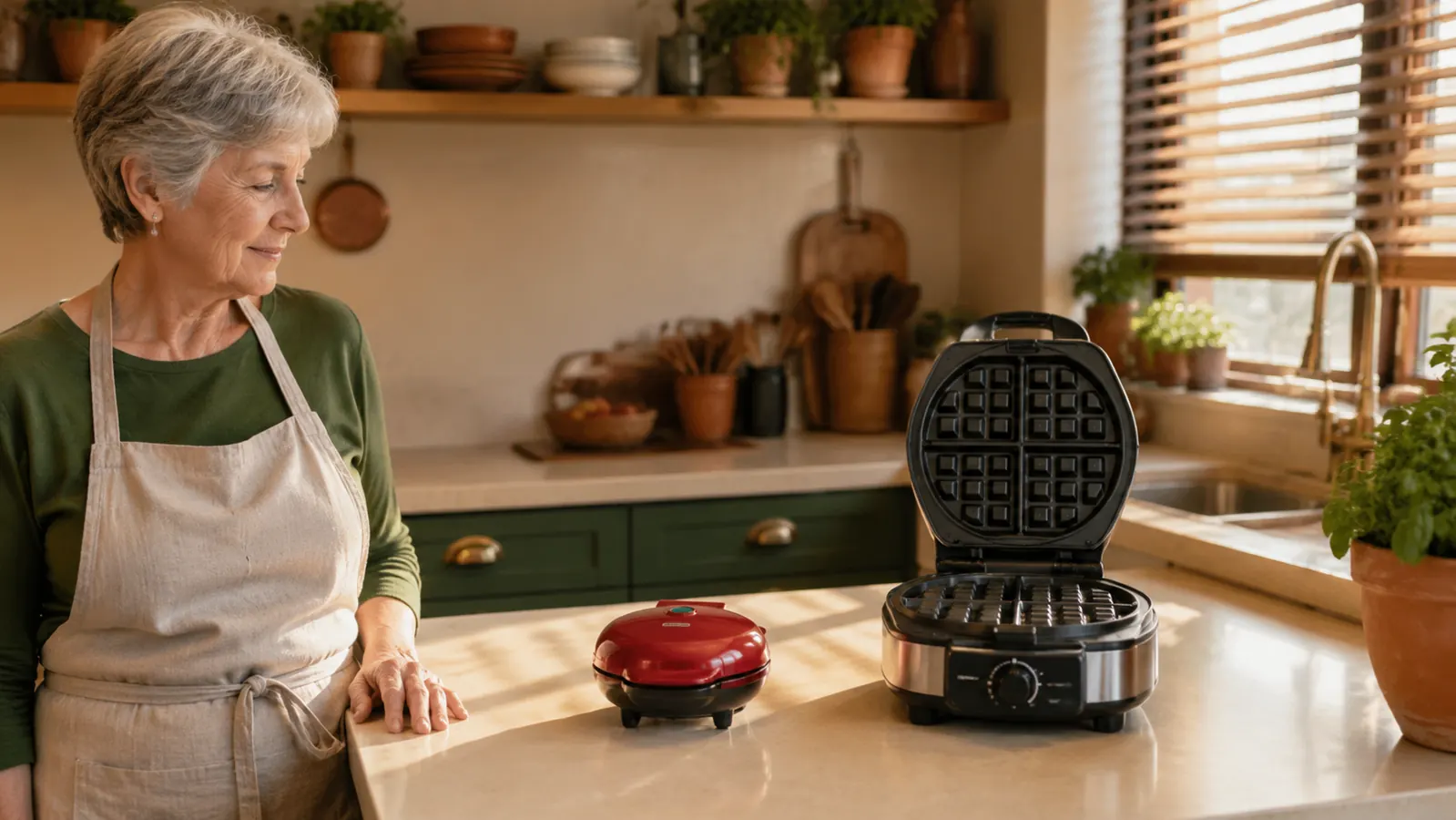
For eleven years I owned a full-size Belgian waffle iron. It made gorgeous, deep-pocketed waffles and it also ate half my counter and lived in a cabinet so awkward I needed both hands and a little luck to get it out without knocking something over. When I moved into my current place, a two-bedroom condo with a kitchen about a third the size of my old one, that iron didn't make the cut. I replaced it with the Dash Mini Waffle Maker, which cost me very little and takes up less room than a dinner plate.
This isn't a hypothetical comparison. I used both irons, the same recipe, in two different kitchens, years apart. If you're trying to decide whether to keep your big Belgian iron or downsize to something like the Dash, here's exactly where each one earns its keep, and where it doesn't.
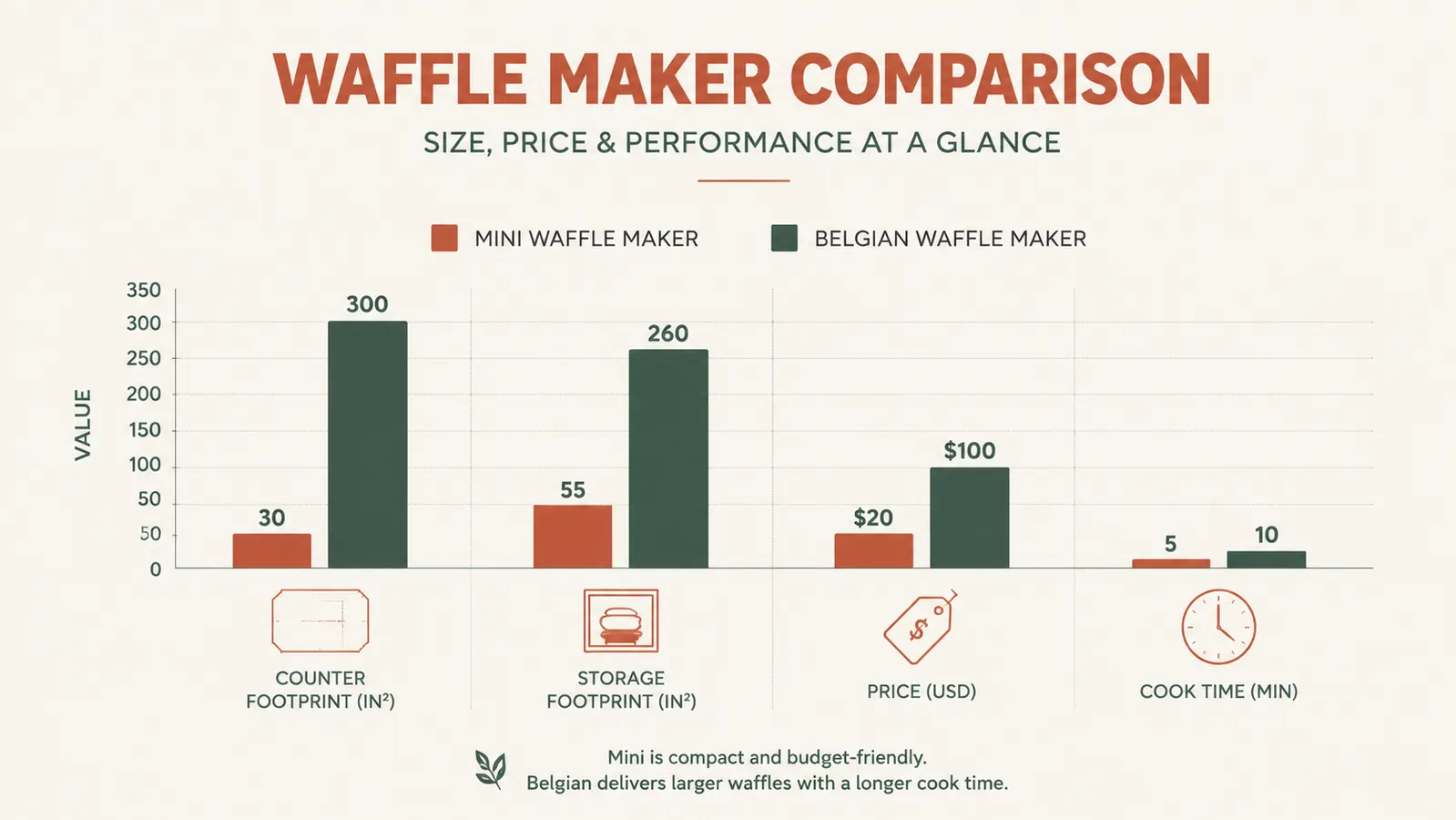
| Dash Mini Waffle Maker | a Full-Size Belgian Waffle Maker | |
|---|---|---|
| Price | Check today's price on Amazon | Mid-range to premium |
| Counter footprint | About 6 x 6 inches, palm-sized | 12 x 12 inches or larger, often with a hinged lid that needs clearance above it |
| Storage footprint | Fits in a drawer or a shallow cabinet shelf | Needs its own dedicated cabinet space, usually stored on its side |
| Waffle size | One 4-inch single waffle per batch | One full 7-inch, four-square Belgian waffle per batch |
| Cook time | About 4 minutes | About 5 to 6 minutes |
| Batter needed | 1/4 cup | 1 to 1.5 cups |
| Cleanup | Nonstick plates wipe clean with a damp cloth, no disassembly | Deep pockets trap batter and syrup, often needs a brush or toothpick to fully clean |
| Best for | Cooking for one or two, kids, quick weekday breakfasts | Feeding a full table at once, deep-pocket Belgian texture, entertaining |
| Power draw | Roughly 350 to 500 watts | Roughly 1,200 to 1,800 watts |
Where the Dash Mini Wins
The honest answer for most people living alone or cooking for two is that the mini wins on almost everything that actually matters day to day. I keep mine in the drawer under my stovetop, standing up on its side, and it takes up less room than a stack of dinner plates. My old Belgian iron needed its own shelf in a cabinet I could barely reach without a step stool. When you're working with a galley kitchen or a condo kitchen with maybe four cabinets total, that difference is not small. It's the difference between an appliance you actually pull out and use, and one that becomes storage clutter you resent every time you open the cabinet.
Portion control is the other place the mini pulls ahead. When I lived alone after my husband passed, making a full Belgian waffle recipe meant either eating way more than I needed or freezing three waffles I'd forget about until they got freezer burn. With the Dash, I measure out a quarter cup of batter, get one perfect waffle, and I'm done. No math, no leftover batter sitting in a bowl going flat while I decide what to do with it. For anyone cooking for one, two, or occasionally a grandkid who wants their own small waffle, that single-serving format solves a real problem the big iron never addressed.
Cleanup is faster too. The Belgian iron's deep waffle pockets are great for holding syrup, which sounds nice until you're the one scraping dried batter out of a diagonal grid pattern with a toothpick. The Dash's shallower nonstick plates wipe clean with a damp paper towel in under a minute, no disassembly, no soaking. My old iron also had removable plates that supposedly went in the dishwasher, but I learned the hard way that the hinge mechanism corrodes if you're not careful about how much water gets near it, so I ended up hand-washing it anyway. The mini never gave me that headache because there's nothing to disassemble in the first place.
There's also the cost of admission to consider. My Belgian iron ran me at the premium level back when I bought it, and replacing a broken one at that price point stings. The Dash costs about what you'd spend on a Sunday brunch out, so if you're not sure waffles are going to become a regular habit, it's a low-risk way to find out without committing real counter space or real money to the experiment.
Skip the counter-hogging iron, keep the waffles
If your kitchen doesn't have room for an appliance that needs its own cabinet shelf, the Dash Mini Waffle Maker solves that without giving up homemade waffles on a weekend morning.
Amazon Check Today's Price on Amazon →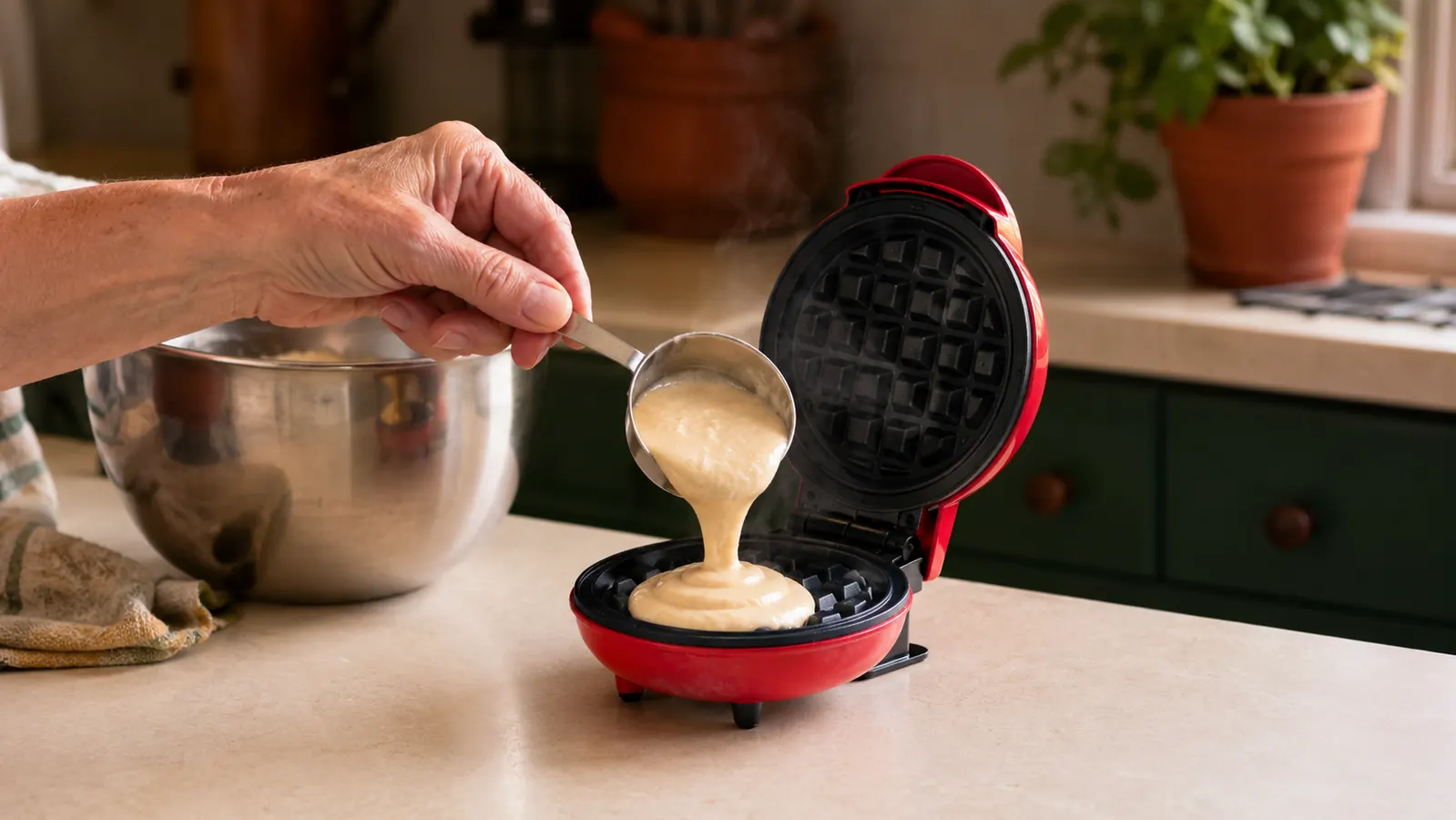
Where a Full-Size Belgian Iron Still Wins
I'm not going to pretend the mini does everything the big iron did, because it doesn't. If you regularly host brunch, feed a family of four or five, or you specifically love the tall, deep-pocketed Belgian style waffle with crisp exterior walls and a soft, almost custardy center, a full-size Belgian iron does that better. The higher wattage on most Belgian irons, often north of 1,200 watts compared to the Dash's roughly 350 to 500, means faster, more even heating and a more consistent golden-brown finish across a bigger waffle.
There's also a batch-speed argument. If you're cooking for a full table, a single Belgian waffle feeds two people comfortably, so you might only need two or three cook cycles to feed everyone. With the mini, you're making four to six individual waffles back to back, which takes longer overall even though each cycle itself is quick. When my daughter and her husband visit with their three kids, I still borrow my neighbor's full-size iron for that one weekend, because five mini waffles at a time isn't practical when everyone's hungry at once.
Texture is the other honest difference. A true Belgian iron has deeper pockets and thicker plates, and that changes how the batter cooks. You get a waffle with more contrast between a crisp shell and a soft, almost airy interior. The Dash makes a good, respectable waffle, but the pockets are shallower and the whole thing cooks a bit more uniformly, so if you're chasing that specific bakery-style Belgian bite, the full-size iron is still the better tool for the job.
The Belgian iron makes a better waffle for a crowd. The mini makes a better waffle for a Tuesday.
Who Should Buy the Dash Mini
If you live alone, cook for one or two most mornings, or you're working with a kitchen where every cabinet inch is already spoken for, the Dash makes far more sense. It's also a smart pick for anyone who wants waffles occasionally rather than as a weekly ritual, since the low price means it's not a painful appliance to own even if it only comes out once a month. Parents making waffles for young kids like the smaller portion size too, since a full Belgian waffle is often more than a small child can finish. I've also given a couple of these as small gifts to friends who just moved into their first apartment, because it's an easy way to have a little homemade comfort without buying an appliance that dominates a tiny kitchen.
A small appliance that earns its drawer space
At its low price point, the Dash Mini Waffle Maker gives up almost nothing that matters for everyday breakfasts, and it never takes over your cabinet the way a full-size Belgian iron will.
Amazon Check Today's Price on Amazon →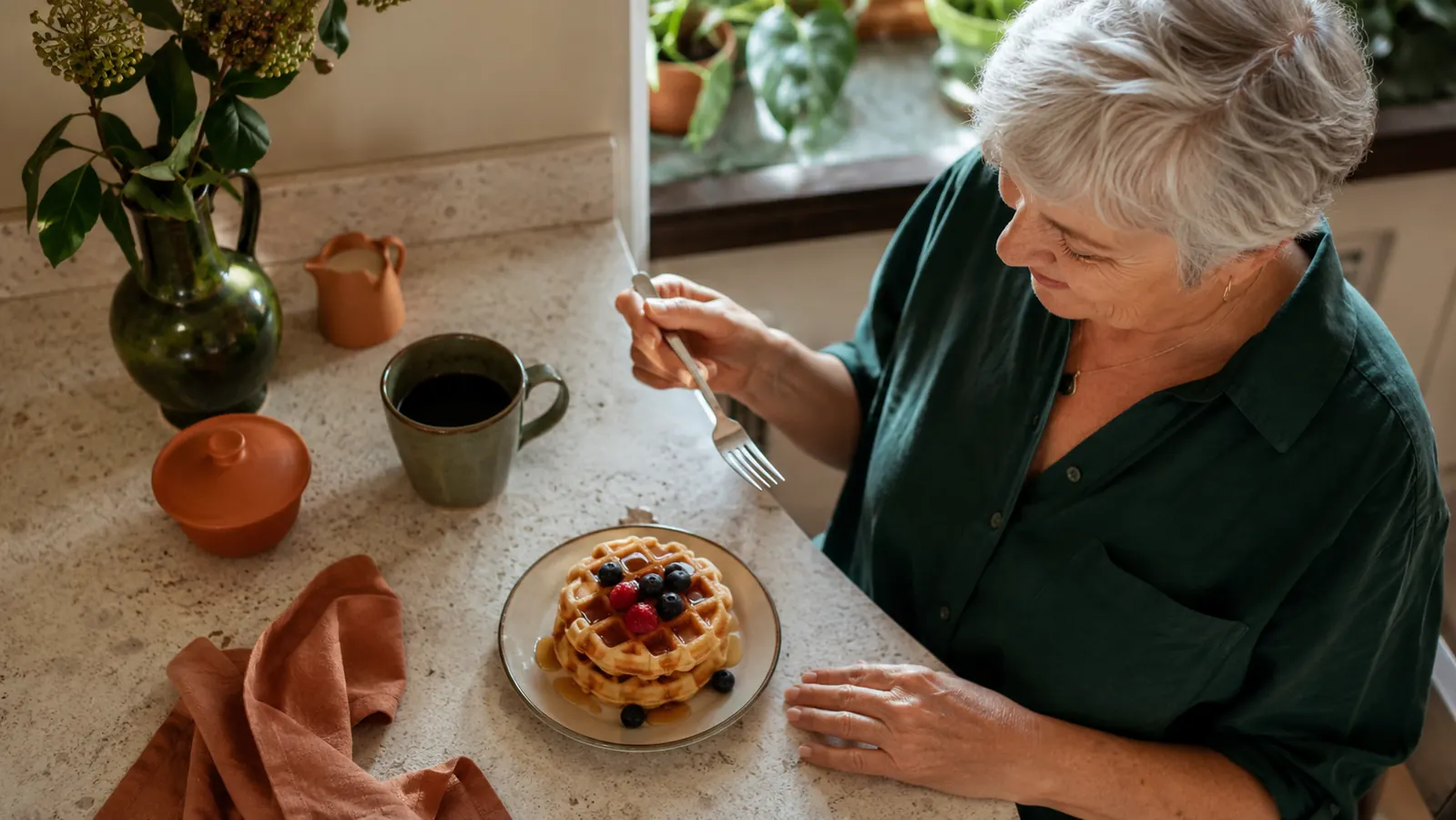
Who Should Buy a Full-Size Belgian Iron
If you have the counter and cabinet space to spare, cook for a household of three or more, or waffles are a standing weekend tradition in your house, a full-size Belgian iron is still worth the investment. It's also the better choice if you specifically want that tall, deep-pocket texture. The mini makes a good, honest waffle, but it doesn't replicate the exact bite of a true Belgian iron. If that texture is the whole point for you, don't downsize just to save cabinet space you might not actually be short on. And if you host holiday brunches or big weekend breakfasts a few times a year, it may be worth keeping both around, a big iron for the crowd mornings and a small one for the everyday quiet ones, which is exactly what I ended up doing before I moved and had to choose.